

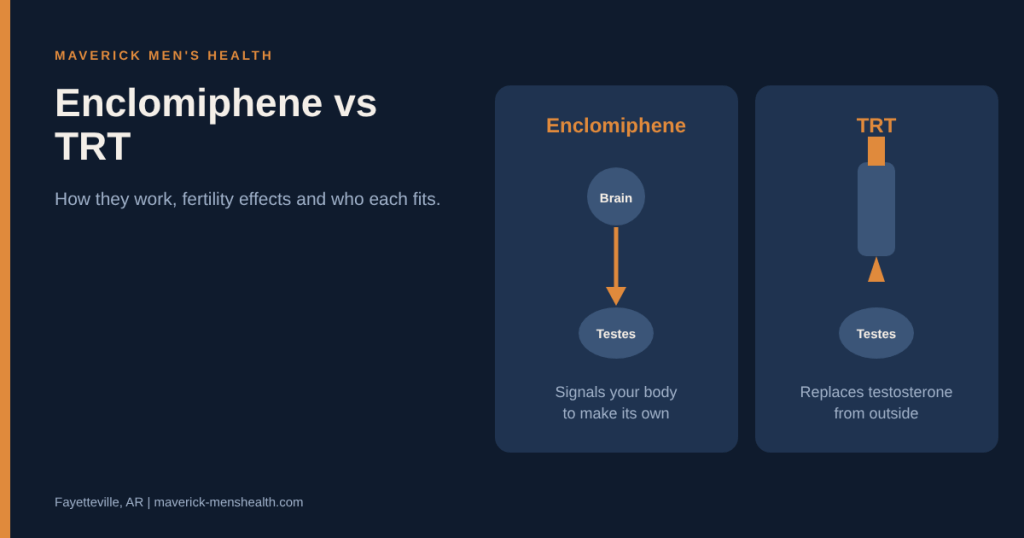
What is the difference between enclomiphene and TRT? Testosterone replacement therapy (TRT) supplies testosterone from outside your body. Enclomiphene is an oral medication that signals your own body to make more testosterone. TRT is more established and works in more situations, but it can lower sperm production. Enclomiphene may preserve fertility, but it is not FDA-approved and has less long-term evidence.
When a man is told his testosterone is low, the next question is often how to raise it. For men who want to keep the option of fatherhood, or who prefer to stimulate their own hormones, enclomiphene vs TRT becomes a real decision.
At our men’s health clinic in Fayetteville, we explain both options and let your lab results guide the conversation. This guide compares how each works, what they mean for fertility, the evidence, the risks and who tends to suit which approach.
How TRT Works
TRT replaces the testosterone your body is not making enough of. Depending on the plan, it is given as injections, gels, creams or pellets. Your blood level rises predictably, and symptoms such as low energy and low drive often improve over the following weeks and months.
The catch is the body’s feedback system. When outside testosterone enters your blood, your brain senses plenty and turns down two signals, LH and FSH, that tell the testes to work. Your testes then make less of their own testosterone and often less sperm. Read more in our guide to TRT and fertility.
How Enclomiphene Works Compared With TRT
Enclomiphene takes the opposite approach. It is an oral medicine that belongs to a group called selective estrogen receptor modulators (SERMs). It blocks estrogen’s “stop” signal at the pituitary gland in the brain. The pituitary then releases more LH and FSH, and your testes respond by making more testosterone and continuing to produce sperm.
Put simply, in the enclomiphene vs TRT question, TRT replaces testosterone, while enclomiphene tries to restore your own production. That difference drives almost every point of comparison below.
A study published in BJU International compared enclomiphene with a testosterone gel in overweight men with low testosterone. Both raised testosterone to a normal range, but sperm concentrations were maintained with enclomiphene and fell with the gel. A summary of the study is available from ScienceDaily.
Enclomiphene vs TRT: Side-by-Side
| Factor | TRT | Enclomiphene |
| How it works | Supplies testosterone from outside | Stimulates your own testosterone production |
| Form | Injection, gel, cream or pellet | Oral tablet |
| Effect on sperm | Often lowers sperm production | Designed to preserve it |
| Testicle size | May shrink over time | Usually maintained |
| Works for | Most causes of low testosterone | Mainly when the brain-to-testes signal is the problem |
| FDA status | FDA-approved testosterone products exist | Not FDA-approved |
| Evidence base | Large, long-term | Smaller, with limited long-term data |
| Monitoring | Testosterone, hematocrit, estradiol, PSA | Testosterone, LH, FSH, estradiol, plus semen testing if fertility matters |
Enclomiphene vs TRT: Who May Be a Better Fit for Enclomiphene?
Enclomiphene works only if your testes can respond to the signal. That is usually the case in secondary hypogonadism, where the issue starts in the brain’s signaling and not in the testes themselves. Labs tell them apart: low or low-normal LH and FSH with low testosterone suggests a signaling problem, while high LH and FSH suggests the testes are struggling.
It may be worth discussing if you:
- Want to preserve fertility now or in the near future.
- Are younger, with low testosterone tied to weight, sleep or stress.
- Have low testosterone with low or normal LH and FSH.
- Prefer a daily oral option over injections or gels.
Who May Be a Better Fit for TRT?
TRT tends to fit when:
- You have no current plans for children.
- Your testes cannot respond to a stimulating signal, such as primary hypogonadism.
- Your levels are very low and you want a predictable, well-studied approach.
- Your plan works better with a steady, adjustable dose.
If you are not sure what low testosterone looks like, see our guides to low testosterone symptoms men ignore and normal testosterone levels by age.
Enclomiphene vs TRT: FDA Approval and Safety
Honesty matters here. Enclomiphene has not been approved by the FDA for any use, and it is typically prescribed off label or through compounding. That does not make it unsafe by default, but it does mean the long-term evidence and regulatory oversight are smaller than for approved testosterone products.
Possible side effects can include headaches, mood changes and shifts in estradiol. Some medicines in this class have been linked to vision changes, so any visual symptoms should be reported to a medical provider right away. TRT has its own risks, including raised hematocrit and sperm suppression, which is why it also needs regular labs.
Neither option is a casual choice. Both should be prescribed and monitored by a medical provider.
How Providers Decide: The Labs Come First
You cannot choose between enclomiphene vs TRT from symptoms alone. A good evaluation includes:
- Total and free testosterone and SHBG, drawn in the morning and usually repeated.
- LH and FSH, which show where the problem starts.
- Estradiol, since hormones are connected.
- Thyroid, blood sugar and other markers, to rule out look-alike causes.
- A semen analysis, if fertility is part of the picture.
The American Urological Association’s testosterone deficiency guideline points to a total testosterone below about 300 ng/dL with symptoms as the basis for diagnosis. Our guide to men’s health blood work explains the rest of the panel.
Can Lifestyle Change the Answer?
Often, yes. Excess body fat, poor sleep, heavy alcohol use and chronic stress can all lower testosterone. Some men raise their levels meaningfully by addressing these before starting any medication. See our article on low testosterone and belly fat and how natural boosters compare with TRT.
What to Expect at Maverick Men’s Health
Our process starts with data, not assumptions.
- Visit one: blood draw and labs. We collect a comprehensive panel, including testosterone, LH, FSH and estradiol.
- Visit two: your results consultation. Your medical provider reviews your results, asks about your family plans and discusses which options may fit. Our care is led by Dr. Gentry and delivered by licensed, credentialed medical providers.
There is no obligation and no pressure. Pricing depends on your plan, and we offer affordable pricing options, so call for details. Financing is available through Cherry and CareCredit. For more about how therapy works, see our testosterone replacement therapy page and what TRT is.
Frequently Asked Questions
What is the main difference between enclomiphene vs TRT?
TRT adds testosterone from outside the body, while enclomiphene prompts your own body to produce more. That is why enclomiphene may preserve sperm production and TRT often reduces it.
Does enclomiphene preserve fertility?
It is designed to. In a published study, sperm concentrations were maintained with enclomiphene, while they fell with a testosterone gel. Individual results vary, so semen testing is the way to know.
Is enclomiphene FDA-approved?
No. It is not FDA-approved for any use and is typically prescribed off label or compounded, so long-term data is more limited than for approved testosterone products.
Is enclomiphene stronger than TRT?
Not necessarily. TRT can raise testosterone more predictably, especially at very low levels. Enclomiphene depends on your body’s ability to respond, so it is a different tool, not a stronger one.
Who should not use enclomiphene?
Men whose testes cannot respond to LH and FSH signals, such as those with primary hypogonadism, usually will not benefit. Your labs show whether it is a fit.
What are the side effects of enclomiphene?
Reported effects include headaches, mood changes and changes in estradiol. Report vision changes to a provider immediately.
Can I switch from TRT to enclomiphene?
Some men do, often to restore fertility. A medical provider should guide any change, because stopping TRT suddenly can bring symptoms back and recovery takes time.
How long does enclomiphene take to work?
Testosterone levels may rise within weeks, and symptom changes follow over a few months. Follow-up labs confirm the response.
Settle Enclomiphene vs TRT With Real Numbers in Fayetteville
Maverick Men’s Health helps men in Fayetteville and across Northwest Arkansas, including Springdale, Rogers, Bentonville and Siloam Springs, understand their testosterone options. Start with labs, tell us your family plans and decide with real data.
Request a Consultation Call: (479) 305-8206 Visit: 1420 E Augustine Ln #7, Fayetteville, AR 72703