
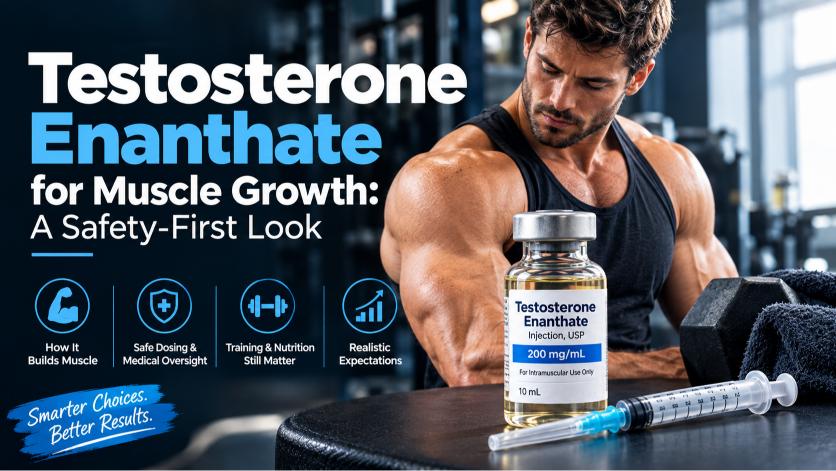
If you’ve been hitting the gym consistently and still aren’t seeing the muscle gains you used to, you’ve probably wondered whether testosterone enanthate could help. It’s a fair question; testosterone genuinely does affect your ability to build muscle, but the honest answer depends heavily on why your progress has stalled in the first place, and on using it the right way.
Key Takeaways
- Testosterone enanthate supports muscle growth mainly by correcting a genuine deficiency, restoring protein synthesis and nitrogen retention to healthy levels.
- Once your testosterone is already in a normal range, adding more doesn’t build proportionally more muscle; it mainly raises your risk of side effects.
- Muscle gains still depend on consistent resistance training and adequate protein intake alongside a properly dosed, physician-monitored protocol.

How Testosterone Actually Builds Muscle
Testosterone is an anabolic hormone, meaning it directly supports the processes your body uses to build and repair tissue. It increases protein synthesis, the process your muscles use to repair and grow after training, and it supports nitrogen retention, a key factor in maintaining a muscle-building environment in your body. When your testosterone levels are in a healthy, optimal range, your body is simply better equipped to respond to the work you’re putting in at the gym.
This is exactly why men with clinically low testosterone often notice that even a solid training and nutrition plan stops producing the results it used to. It’s not that the effort or program is wrong; it’s that a hormonal deficiency is limiting how much of that effort your body can actually convert into muscle.
Why This Only Works as Intended Within a Therapeutic Range
Here’s the part that gets lost in a lot of online discussion: testosterone’s muscle-building effect is strongest when it’s correcting an actual deficiency, restoring your levels to a healthy, normal range rather than pushing them artificially high. Once your levels are already adequate, adding more doesn’t produce proportionally more muscle; it mainly increases your risk of side effects without a matching benefit.
This is the core difference between medically supervised testosterone replacement therapy and the supraphysiological dosing associated with performance-enhancement use. A therapeutic protocol is designed to bring a deficient man back to a normal, healthy level. It’s not designed, and shouldn’t be used, to push testosterone levels well beyond what your body would naturally produce in an attempt to maximize muscle gain. That distinction is exactly why this kind of treatment requires a licensed physician’s oversight rather than a self-directed dosing plan.
What a Safe, Effective Approach Actually Looks Like
If low testosterone is genuinely part of why your muscle-building progress has stalled, a real treatment plan starts with bloodwork, not guessing. A comprehensive lab panel confirms whether your levels are actually low and rules out other causes for slow progress, since fatigue, poor recovery, and stalled strength gains can stem from several different issues, including sleep, nutrition, thyroid function, and training program design, not testosterone alone.
From there, a properly dosed and monitored testosterone enanthate protocol, prescribed based on your specific bloodwork, restores your levels to a healthy range, which is where testosterone enanthate’s muscle-supporting effects actually come from. Combined with consistent training and adequate nutrition, this gives your body what it needs to respond to your workouts the way it’s supposed to. The muscle-building benefit comes from correcting the deficiency, not from exceeding it.
The Role of Diet and Training Still Matters
Even with optimized testosterone levels, hormone therapy isn’t a replacement for the fundamentals. Progressive resistance training and adequate protein intake remain the primary drivers of muscle growth. Testosterone therapy addresses one piece of the equation, removing a hormonal obstacle that may have been holding your results back, but it works best as part of a complete approach, not a standalone shortcut.
Why Monitoring Matters for This Specific Goal
Men focused on muscle growth sometimes feel tempted to push their dose higher than what’s medically indicated, assuming more will mean faster results. This kind of decision should always run through a physician, not be made solo based on how the workouts are going. Regular bloodwork tracks not just your testosterone levels but also markers like red blood cell count and estrogen conversion, both of which can shift in ways that create real health risks if dosing isn’t carefully managed. A properly run protocol adjusts your dose based on how your body is actually responding, keeping you in a range that’s both effective and safe.
Frequently Asked Questions
Does testosterone enanthate build muscle on its own, without exercise?
Testosterone therapy supports muscle-building processes, but meaningful gains still require resistance training and adequate nutrition. It corrects a hormonal limitation; it doesn’t replace the work.
How much muscle can I expect to gain?
This varies significantly based on your starting testosterone levels, training consistency, diet, and genetics. Men correcting a genuine deficiency often see improved recovery and strength over several months, but individual results vary and shouldn’t be compared to bodybuilding-specific, high-dose use.
Is it safe to increase my dose to build muscle faster?
No. Dosing above what your bloodwork indicates increases health risks without a proportional benefit, and it should never be adjusted outside your physician’s guidance.
How do I know if low testosterone is actually why my progress has stalled?
The only reliable way to know is bloodwork. A comprehensive lab panel is the starting point before assuming testosterone is the missing piece.
Find Out If Low Testosterone Is Holding You Back
At Maverick Men’s Health in Fayetteville, AR, we help men understand what’s actually behind stalled progress in the gym, whether that’s a hormonal deficiency, a training or recovery issue, or something else entirely. Every testosterone protocol here is built around real lab results and monitored by a board-certified physician, never a generic dose aimed at maximizing gains regardless of risk.
Visit: 1420 E Augustine Ln #7, Fayetteville, AR 72703